
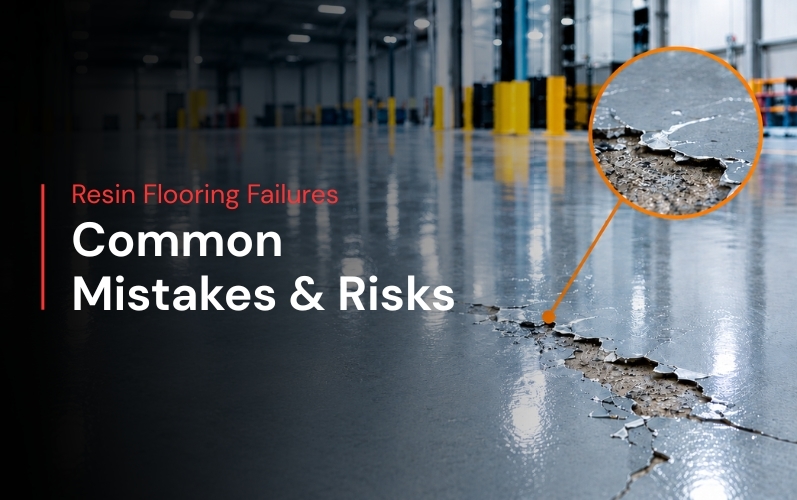
What Happens When Resin Flooring Is Installed Incorrectly? Common Mistakes, Delamination & Bubbling
As a leading industrial flooring solution provider in Ireland, we aim to keep our clients satisfied for years. We have received several jobs over the years for cases where resin flooring is not installed correctly.
In most cases, we have found these to be the common mistakes. Many installers are not even conscious of these issues. These small root causes include poor surface preparation, excess moisture in the concrete slab, incorrect mixing or application, and environmental conditions outside the product’s limits. These mistakes can lead to bubbling and premature delamination. In the worst cases, it affects the specified performance.
In this blog, we will cover more about what causes failure of resin floors and common mistakes in delamination.
Key Takeaways
- Proper surface preparation helps the resin bond well and prevents peeling.
- Always check moisture, temperature, and humidity before installation.
- Mix the resin and hardener slowly and use the right tools for application.
- One must ensure slow mixing and the use of appropriate equipment when applying the resin.
Where Can Resin Flooring Installation Go Wrong?
Focus on the concrete substrate: If the installer fails to remove laitance, dust, oil, or old sealers, this weakens surface layers. This compromises the bond to the concrete substrate because the resin can’t adhere to it properly, which leads to caking, peeling, and delamination.
Skipping or Using an Incompatible Primer on Porous Surfaces: Primer is necessary for resin flooring. It seals the concrete and improves the resin strength by improving the bond. Because primers have low viscosity, they can fill pores in the substrate and improve surface strength. Many installers go wrong with the primer. This can cause bubbling and blisters as the trapped air escapes during curing.
Moisture in the slab: High levels of internal relative humidity or moisture vapor emission from concrete. This is the most common reason for resin flooring installation failure. Ideally, the substrate should have less than 6% moisture, while indoor humidity should stay below 70%. Otherwise, vapor pressure lifts the film, producing blistering, delamination, and efflorescence.
Incorrect Floor Mixing: Sometimes many floor installation experts go wrong when mixing. Mixing the resin and hardener at too high a speed (i.e.>500 rpm), for too long, or with an incorrect ratio is wrong. Air can get trapped in the mixture. Resin will not cure properly, disrupting the cure chemistry. This can result in the formation of bubbles and/or soft or gummy areas. It’s always better to use a slow-speed, high-torque mixing device instead of a regular household drill.
Here is a pro tip: don’t mix it too fast; this can trap air. We don’t recommend hand mixing either. This can leave parts of the mixture uneven. Mix slowly and scrape the sides and bottom of the container.
Wrong tools/application methods: Many installers also go wrong in choosing appropriate application tools. Using incorrect rollers (nap size), rolling too hard, or otherwise over-working the resin will result in the introduction of air and voids. Always choose the manufacturer-recommended tool.
Environmental extremes: Applying the product in temperatures that are too cold/hot or with high relative humidity will alter cure rate. This may cause bubbles to form or an incomplete cure. Ideally, keep both the floor surface and the air temperature between 20°C and 25°C while mixing and applying the product. Bring the resin to the site at least 30 hours before installation. This will allow it to adjust to the site conditions.
Delamination: Common Causes and Signs
Delamination occurs when the resin floor separates from the underlying concrete during curing, causing areas to bubble up, peel away, or come off in large sections.
One simple way to spot delamination is to tap the floor. Hollow-sounding areas can be a warning sign. If you notice lifting or peeling, keep it in checks.
What Causes Delamination?
Poor surface preparation:
The epoxy needs a clean and properly prepared surface to bond well. Dust, oil, laitance, old sealers, or other contaminants can get between the concrete and resin. This can weaken the bond and cause the coating to lift.
Moisture in the substrate:
Moisture can also cause serious bonding problems. If water vapor is trapped below the resin, pressure can build up and push the coating away from the concrete. This is why checking moisture levels before installation is so important.
Using the wrong primer or flooring system:
The primer, resin, and topcoat need to work well together. Using products that are not designed to work as a system can affect the bond and the overall performance of the floor.
Missing the recoat window:
Each resin product has a recommended time for the next coat. Waiting too long or contaminating the previous coat could lead to adhesion issues. Same with a surface that’s too smooth to allow the subsequent layer to adhere properly.
Read our blog on choosing the right resin floor installer in Ireland.
Bubbling and Blistering: Causes and Signs
Bubbling and blistering are other common problems associated with resin floors. You may notice small pinhead bubbles or clusters of bubbles.
Sometimes these problems appear while the resin is being applied. In other cases, they show up after the floor has started to cure.
What Causes Bubbling and Blistering?
Air trapped during mixing:
Mixing the resin too quickly can pull air into the product. Aggressive rolling can also trap air. These air pockets may then appear as bubbles on the finished floor.
Outgassing from the substrate:
Concrete has tiny pores that can release air as the temperature changes or the resin starts to cure. If the surface is not properly primed, this air can move into the resin and create bubbles.
Moisture below the floor:
Damp concrete may give off water vapours during the curing process of the resin. This may cause a pressure build up underneath the coating, which may result in bubbles and larger blisters.
Incorrect temperatures:
Temperature can affect how easily air escapes from the resin. If the substrate or product is too cold, bubbles may not rise and escape before the resin starts to set.
The good news is that many of these problems can be avoided. You will need the right installation strategy using proper surface preparation, moisture checks, correct mixing, and ensuring the right conditions.
How to Prevent Resin Flooring Installation Failure?
| Problem | Prevention & Fix |
|---|---|
| Moisture | Test the slab first. Fix moisture issues before installation or repair. |
| Poor surface prep | Grind, clean, and vacuum the surface properly. |
| Poor adhesion | Use the right primer and make sure the surface is clean and dry. |
| Bubbles & blisters | Mix gently, control outgassing, and avoid moisture under the coating. |
| Delamination | Remove loose areas, re-prepare the surface, and reapply the system. |
| Wrong conditions | Keep temperature and humidity within the product limits. |
| Poor application | Use the right tools, apply even coats, and follow recoat times. |
Final Thought
Resin flooring failures usually stem from installation mistakes, which you can avoid by following proper preparation and coating-application techniques. A few simple steps will ensure a high-quality floor that will last for many years.
Want to avoid common resin flooring problems? Trust Acrylicon Ireland. We are one of the trusted industrial flooring suppliers in Ireland. We can help you choose the right products and provide end-to-end installation for a durable finish. Get in touch with our team today.
Frequently Asked Question
How can I stop resin flooring from delaminating?
Start with proper surface preparation and check the moisture level before installation. Use a compatible primer and follow the correct mixing and recoat times.
Can temperature affect resin flooring installation?
Yes, very high or low temperatures can affect how the resin cures. Keep the site within the product’s recommended temperature and humidity range.
