
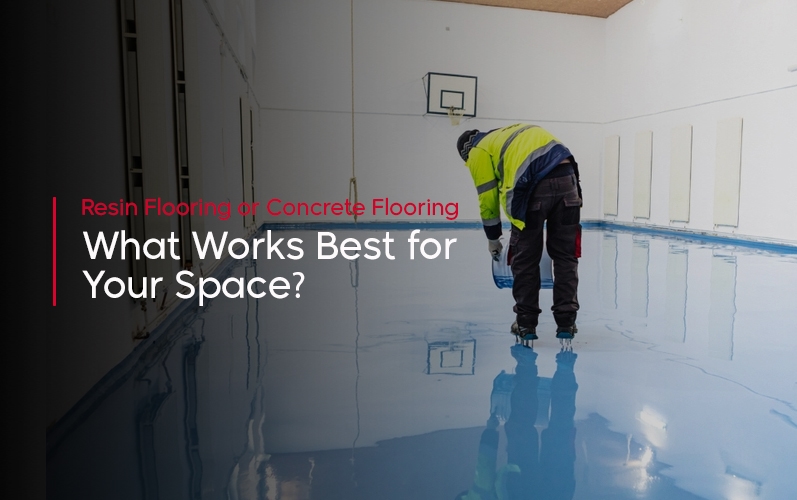
Resin Flooring vs Concrete Flooring: Which Is Better?
We have worked on 1000+ commercial and residential flooring projects. With 15+ years of experience, we can definitely tell you more about resin flooring vs. concrete flooring.
Resin flooring can be a better alternative to a concrete floor. You can get the same strength and durability. That also, in a less upfront cost, comparable to polished concrete. Plus, you can customize its appearance by choosing a color and a pattern. Resin floor also offers better floor safety with chemical resistance and hygiene.
If you are looking for a seamless flooring solution for your facility, keep reading the blog!
Key take away
- Resin floor solutions are a good choice if you need a highly durable surface.
- For easy maintenance, better hygiene, and chemical or slip resistance, resin is a better option.
- Concrete flooring has a lower initial investment. However, compared to traditional concrete, resin flooring provides better long-term value.
- Resin flooring is a fully seamless and customizable type of flooring system. It is good for use in new or renovated commercial/industrial buildings.
- Choose the right flooring between concrete and resin based on your requirements. It includes your facility’s daily use, traffic, safety needs, and maintenance expectations.
Resin Flooring Vs Concrete Flooring: A Decision Table
| Decision Factor | Resin Flooring | Concrete Flooring |
|---|---|---|
| Upfront Cost | Slightly higher upfront cost but lower maintenance later | Lower starting cost for basic installation |
| Long-Term Value | Durable and cost-effective over time | May need repairs and sealing over the years |
| Durability | Resistant to cracks, chemicals, stains, and moisture | Strong structure but can crack with temperature changes |
| Maintenance | Easy to clean and maintain due to seamless finish | Needs regular maintenance and surface care |
| Hygiene | Non-porous and seamless, helps reduce bacteria and moisture build-up | Porous surface can trap moisture and dust |
| Slip & Chemical Resistance | Can include anti-slip and chemical-resistant protection | Can become slippery and is vulnerable to chemical spills |
| Visual Appearance | Custom colours, finishes, and modern designs available | Natural industrial look with limited design flexibility |
| Installation Time | Faster curing and quicker return to use | Longer installation and curing process |
| Environmental Impact | Lower waste and low-VOC options available | Higher carbon footprint during cement production |
| Best Suited For | Warehouses, retail, gyms, labs, garages, commercial facilities | Structural slabs, base floors, light-use areas |
Resin Flooring Vs. Concrete Flooring
Affordability
Resin flooring in Ireland is comparatively cheaper than raw concrete. Its upfront cost is high. However, the polished concrete comes with a higher price tag than resin flooring. The resin flooring installation cost is not economical. However, its durability and low maintenance pay off in the long run. Concrete flooring is a good option for a tight budget. It has a low upfront cost. However, it needs good maintenance to prevent moisture. Has vulnerabilities to temperature fluctuations.
Strength and Durability
Resin flooring offers more strength and durability. A well-cared resin floor lasts on average 25 years. Plus, it does not shrink or is less likely to crack. As a seamless flooring solution, resin floor is also resistant to mould. With polyurethane finishes, it does not yellow. Concrete flooring has a strong structure. However, it is not chemical-resistant and cannot be worn without the right maintenance.
Cleanliness and Hygiene
Resin flooring is easy to clean. Plus, you can install it with germ or bacteria resistance protection. As this has a seamless, non-porous surface and has no grout lines or gaps, it does not trap moisture or bacteria. Concrete flooring is also easy to clean. However, the non-polished ones have pours that trap moisture. Check out our blog to know more about resin floor basics.
Chemical and Slip Resistance
The biggest advantage of resin flooring is its chemical, stain, and slip resistance. Both enhance the safety of your flooring. There will be no risk of slipping or damage to the floor. Plus, the downtime will be low as the resin floor does not hold on to moisture. On the other hand, a concrete floor can be slippery. It does hold on to moisture. Plus, it is vulnerable to acid or chemical spills.
Visual Appeal
Resin flooring in Ireland comes with a range of colors and patterns. You can customize your flooring to fit your facility’s theme. On the other hand, polished concrete floors have more natural finishes. Its color can change after it finishes.
Installation Process
Resin flooring has a faster installation time than concrete. Plus, resin flooring drying time is also fast. After the application, the resinous coating completes itself within 1 to 2 days. Concrete takes more time for installation. It needs sufficient time. You can get it ready for use within 4 to 7 days.
Environmental Friendly
Resin flooring is made of solvent-free chemicals. It does not release VOC and dust. Seamless resin flooring coating reflects light by 300%. It saves energy costs. Epoxy flooring also creates less material waste compared to tile or traditional concrete. The concrete floor is not dust-free. During the manufacturing of concrete, a high amount of carbon emissions is created. It has a larger carbon footprint. It is completed in 3 to 7 days.
Read our blog on resin flooring vs tiles for more insights.
When Should You Choose a Resin Floor Over Concrete?
Resin flooring is a good seamless flooring solution for commercial settings. In a warehouse, factory, garage, gym, lab, or even in a retail store, it can be a good option. If you handle heavy traffic or if your floor handles chemicals, moisture, or frequent cleaning, resin flooring usually offers more protection. Concrete makes more sense for slabs and load-bearing bases. As it shrinks due to temperature fluctuation, many businesses should opt for resin flooring in Ireland.
It is definitely a cost-effective and safe choice. Another reason people move from concrete to resin is maintenance. You can use flooring to add a protective layer to a resin floor. Save it against germs, chemicals, slips, and moisture, Design can also be a factor. If you want a cleaner, more modern finish with color choices, a concrete floor is not a good option at all.
So, if you simply need a basic structural surface, concrete may be enough. But if you want better protection, easier maintenance, improved hygiene, a resin finish is a better choice.
Final Thought
Both resin flooring and concrete have advantages and disadvantages. It ultimately comes down to the way you use the space and what you expect your floor will do for you. Concrete makes a good base because of its strength. However, resin will add durability and protection, as well as hygiene and possible design flexibility, to your floor. If you want easy maintenance, higher resistance, and long-lasting performance, resin flooring will typically be the better option of the two. Need guidance for your flooring project? Reach out to our team now!
Frequently Asked Questions
How can I choose flooring for my commercial facility?
Start by thinking about your daily operations. Consider things like foot traffic, temperature fluctuation, hygiene needs, cleaning routines, and budget. Think about how you would love to see your facility, then choose the flooring options.
